
Asian Games 2026: India Open Title Defence with 42–21 Win over Bangladesh
The India–Iran match at 8:30 remains ahead, but India’s 42–21 win over...
The India–Iran match at 8:30 remains ahead, but India’s 42–21 win over Bangladesh already offers a sketch of the next test. Eleven of India’s 42 points came from bonus raids; two all-outs added four more. The 21-point margin matters, but the sharper signal lies in how it was built: India found bonus points against a fully staffed defence while denying Bangladesh the same route.
In kabaddi, a raider enters the opposing half and attempts to score through a touch or a bonus-line crossing before returning safely within the allotted time. Defenders can stop the raider with a tackle. If every player on one side is put out, that team suffers an all-out and the opposition earns additional points. These rules can move the scoreboard quickly. A 21-point margin signals control, but understanding the match requires asking where the points came from.
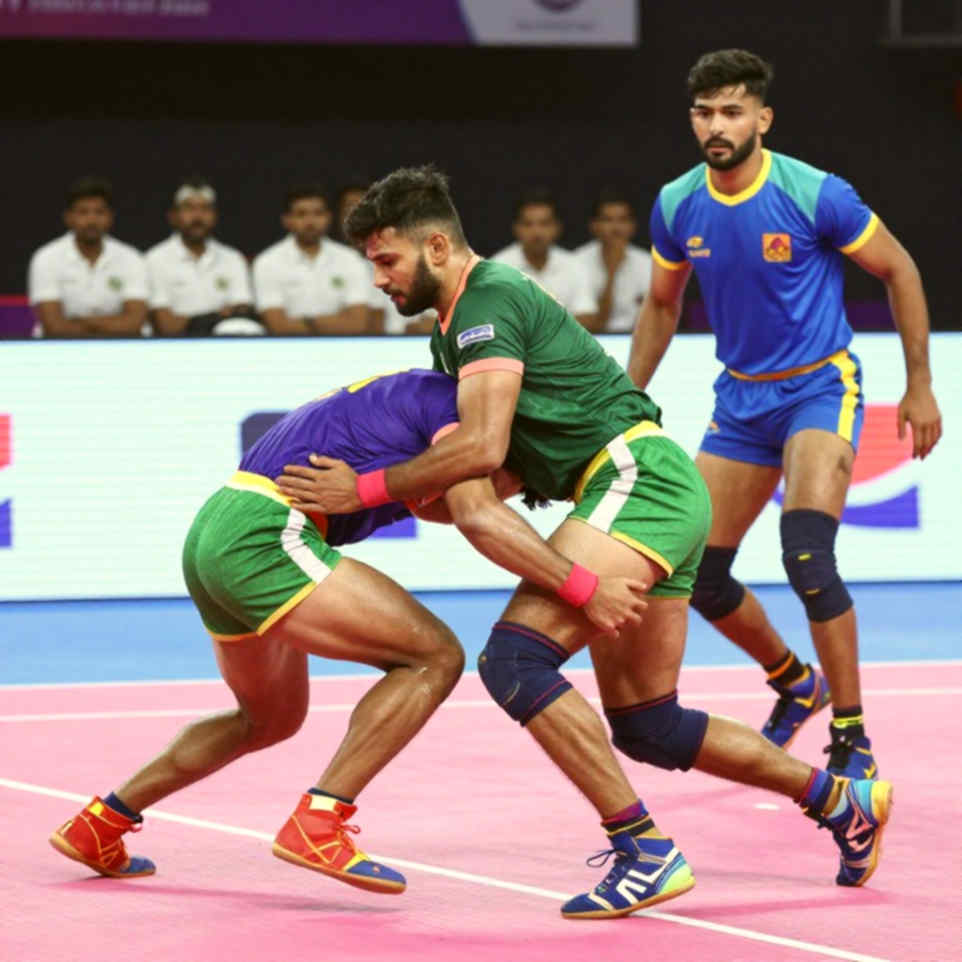
India’s attack was spread across several players. Sanju Devi led the scoring effort and helped restore control when Bangladesh began to close the gap. Sonali Shingate, captain Pushpa Rana and Pooja also contributed. That distribution matters: if an opponent contains one raider, India still has other routes to points. The Bangladesh match showed that range; it did not yet prove how well it will hold against Iran.
India’s defence did not simply retreat and wait. It maintained a high line that made it difficult for Bangladesh’s raiders to reach the bonus line. A bonus point is available when a raider crosses the marked line while at least six defenders are on court. A raider entering a fully set defence accepts risk, but if the defensive line forces an early retreat, Bangladesh loses access to that extra scoring route. The report identifies Manisha Kumari as particularly effective at left cover, an important interior defensive position used to close a raider’s escape route.
India’s 11 bonus points signal an attack willing to raid deep, but they are not a complete measure of raiding efficiency. Bonuses accounted for about a quarter of India’s 42 points. That proportion suggests repeated attempts to enter a set defence and collect a reward. Yet the published report does not provide the number of raids, successful-raid percentage or points per raid. The total indicates a pattern; it cannot, by itself, measure the quality of every attempt.
The two all-outs also helped create the margin. When every player on a team is put out, the opposition receives points and the eliminated players return to court. An all-out is therefore more than a short burst of scoring: it can interrupt the other side’s rhythm and alter the match’s balance. India led 21–10 at half-time. Bangladesh still narrowed the gap for a spell, a reminder that a large lead in kabaddi does not automatically make the closing minutes safe.
Bangladesh captain Sraboni Mollick played the main role in keeping her team on the scoreboard. That is recognition of her contribution and a possible sign of offensive dependence. India’s points were reported across at least four named players, while the available account does not describe an equally broad contribution from Bangladesh. The report does not publish a complete individual raid-point table, however, so the extent of Bangladesh’s dependence on Mollick cannot be measured with confidence. Bangladesh also scored one Super Tackle point, awarded when a successful tackle is made with three or fewer defenders on court. It was a small but meaningful sign of resistance under pressure.
The report says Bangladesh reduced the margin with five minutes remaining. It does not establish whether India eased its intensity or briefly lost defensive shape. It would be unsafe to infer substitutions, rest plans or instructions from that account alone. Still, the closing passage offers a warning: India protected its lead against Bangladesh, but a similar lapse against stronger opposition could turn a few minutes into a decisive stretch.
Based on my years of watching matches, the telling moment is often the point after a team has scored, when it has to decide whether to change its calculation of risk. Every kabaddi raid requires a player to read time, breath, distance and the defenders’ positions together. In athletics, a slight loss of pace can matter in the home straight; in kabaddi, consecutive empty raids can give the opposition a chance to increase pressure. The comparison is only about rhythm: a raid, a tackle and a track race are different contests.
India’s regular scoring raids gave the team continuity. After two consecutive empty raids, the third becomes a do-or-die raid: if the raider scores nothing, the raider is out. The report does not mention such a sequence. That absence is consistent with the idea that India scored regularly, but without a full raid log it remains an inference rather than a verified finding. Against Iran, the question becomes sharper: can India keep finding safe points, or will its raiders be pushed into repeated high-risk attempts?
India has begun its title defence well, but one win cannot establish its gold-medal credentials. The next major focus is Iran. Khel Now’s match report lists India–Iran for September 23 at 8:30 a.m. The information provided here does not include an independently verifiable schedule or time zone. The report describes Iran as a formidable opponent. A 21-point win over Bangladesh matches the expected result; the Iran fixture will show how India’s attack and defence respond to higher-level pressure.
Three details will matter. If Sanju Devi is contained, can Shingate, Rana and Pooja share the offensive responsibility? Can the deep raiding suggested by India’s 11 bonus points work against Iran’s defence without excessive risk? And can India maintain its defensive discipline in the final five minutes? Answering those questions requires more than the final score: successful-raid rate, tackle points, player-by-player contributions and a late-game score breakdown would all help. The published report provides none of those figures.
That data gap matters. The account gives India’s 11 bonus points and four points from two all-outs, but does not break down the remaining points, total tackles or individual player statistics. It also does not identify an official statistical database as the source. Manisha Kumari’s defensive contribution and Sanju Devi’s raiding efficiency therefore cannot be graded with precise percentages. The result is clear; some explanations of how the result was produced still need verification.
India’s win also sits within the wider structure of women’s kabaddi. A national-team tournament such as the Asian Games is among the most visible international stages available to many players. The absence of a regular women’s professional league comparable to the men’s Pro Kabaddi League limits opportunities for earnings, consistent high-level competition and year-round engagement with supporters. Success at the Asian Games can therefore affect more than the medal table: it can influence visibility, participation and conversations about investment. This match report provides no basis, however, for estimating broadcast revenue, sponsorship or player salaries.
Kabaddi has a strong cultural presence in Bangladesh, but popularity alone does not create an elite women’s team. That requires regular competition, coaching, strength and conditioning, and systems that help players remain in the sport. India also depends on more than talent: training opportunities and career security matter. Stable employment, including public-sector roles, can help athletes continue competing. The match report does not describe the players’ individual contracts or either country’s investment, so the 42–21 margin cannot be assigned to any one structural cause.
The most defensible reading is that India performed as the more complete team on the day: its attack involved several players, it collected bonus points and it inflicted two all-outs. Bangladesh’s score prominently involved captain Sraboni Mollick, while the team also earned a Super Tackle. This supports the conclusion that India controlled the match. It does not reveal how many tackles each player made or how much each position contributed. A clean win is evidence of team strength, but that evidence must be tested again when the opposition changes.
Kabaddi’s physical contact also brings injury exposure. Rapid changes of direction, leg holds, loss of balance and group tackles place demands on the knees, ankles and shoulders. The report mentions no injuries, and there is no reason to imply that any occurred. In a short tournament, though, recovery, substitutions and medical support matter when matches arrive in succession. A winning margin alone cannot reveal the players’ workload; match minutes and rotation data would be needed.
I watched Neeraj Chopra’s 85.23-metre javelin throw and Dutee Chand’s 11.32-second sprint at the 2026 Asian Athletics Championships in Bhubaneswar. That experience taught me that attention usually falls on the winner, while the small positions often reveal how a contest is built. “The Sixth Lane is where the race stops performing and starts telling the truth.” In kabaddi, the equivalent can be left cover, the supporting raider or the final minutes of a lead. The brief mention of Manisha Kumari’s role is more than a name: it opens the question of who, and where, helped the defence gain control.
In 2026, an editor removed part of my tactical analysis of Croatia’s midfield and told me to leave tactics to the boys. Since then, I have treated formations as more than neutral diagrams. “When they said leave tactics to the boys, I started reading formations like a dissent.” Here, the high defensive line and the contest around the bonus line are part of the match’s argument: which side is forcing the other to enter dangerous territory, and which can manage that risk? The published details remain limited, however. Without video analysis or a moment-by-moment account, the full shape of the defensive system cannot be claimed.
A further long-term question is the breadth of international competition. Strong India and Iran teams can raise the standard of women’s kabaddi, but if high-level competition remains concentrated among only a few countries, the sport’s global development may remain slow. Countries such as Bangladesh may have a broad base of participation without yet converting it into sustained international results. The Asian Games provides an important stage, but one tournament cannot substitute for regular leagues, coach development and competition across more regions.
India’s win over Bangladesh is therefore both a definite result and incomplete evidence. The result says India controlled the opener. Eleven bonus points and two all-outs show that deep raids and sustained pressure helped build the margin. Contributions from several named players suggest the attack may be less dependent on a single raider. But without successful-raid rates, tackle points and a complete final-five-minute breakdown, the degree of tactical superiority cannot be measured precisely.
“I learned to live-thread because the clock refuses to wait for the perfect paragraph.” Kabaddi’s clock waits for no one either: a raid, a tackle or an all-out can change the value of the next decision. India’s next chapter is not a repeat of the Bangladesh match. The real test is whether its bonus-heavy attack can hold up against Iran, whether the defence stays composed late, and whether several raiders can share the pressure. India’s title defence should be judged against that fixture and the detailed statistics that follow it.