
KabaddiThe Arithmetic of Three All Outs: India's Women Reach the Asian Games Final With a 48 24 Win Over Nepal
The Arithmetic of Three All Outs: India's Women Reach the Asian Games Final With a 48 24 Win Over Nepal
**মূল উত্তর:** ভারতের মহিলা কবাডি দল এশিয়ান Games ২০২৬-এর সেমিফাইনালে নেপালকে ৪৮-২৪ পয়েন্টে হারিয়ে ফাইনালে পৌঁছেছে। জয়ের ভিত্তি তিনটি অল-আউট ও ৩৫ রেইড পয়েন্ট; ফাইনাল ২৬ সেপ্টেম্বর ২০২৬, প্রতিপক্ষ ইরান বনাম চাইনিজ তাইপেই সেমিফাইনালের বিজয়ী। **মূল তথ্য:** - চূড়ান্ত স্কোর ভারত ৪৮, নেপাল ২৪; প্রথমার্ধে ভারত এগিয়ে ছিল ৩১-১৭। - ভারত তিনটি অল-আউট পেয়েছে, দুটি প্রথমার্ধে; এতে ৬ বোনাস পয়েন্ট যোগ হয়। - ভারতের রেইড পয়েন্ট ৩৫, প্রথমার্ধেই ২৩; প্রথমার্ধে ৪টি বোনাস লাইন পয়েন্ট। - নেপাল প্রথমার্ধে ১৩ টাচ পয়েন্ট পেয়ে দ্বিতীয়ার্ধে নেমে আসে ৫-এ। - সানজু দেবীকে ভারতের রেইডিং আক্রমণের কেন্দ্র হিসেবে চিহ্নিত করা হয়েছে; ব্যক্তিগত পয়েন্ট প্রকাশিত হয়নি। **সূত্র:** Khel Now-এর ম্যাচ প্রতিবেদন; ফাইনাল ২৬ সেপ্টেম্বর ২০২৬-এর আগে প্রকাশিত। **সম্পর্কিত প্রশ্নোত্তর:** প্রশ্ন: নেপাল আসলে কত পয়েন্ট পেয়েছে? উত্তর: চূড়ান্ত স্কোর ২৪; কোথাও '১৮' লেখা থাকলে সেটি নেপালের টাচ পয়েন্ট হিসেবে ধরা উচিত। প্রশ্ন: ফাইনালে ভারতের প্রতিপক্ষ কে? উত্তর: ইরান বনাম চাইনিজ তাইপেই সেমিফাইনালের বিজয়ী, ম্যাচ ২৬ সেপ্টেম্বর ২০২৬। প্রশ্ন: এই জয়ের বাণিজ্যিক তাৎপর্য কতটা? উত্তর: সীমিত, কারণ ভারতীয় পুরুষদের প্রো কাবাডি Leagueের কোনো মহিলা প্রতিরূপ নেই, তাই সাফল্য আয় বা বেতনে রূপান্তরিত হয় না।
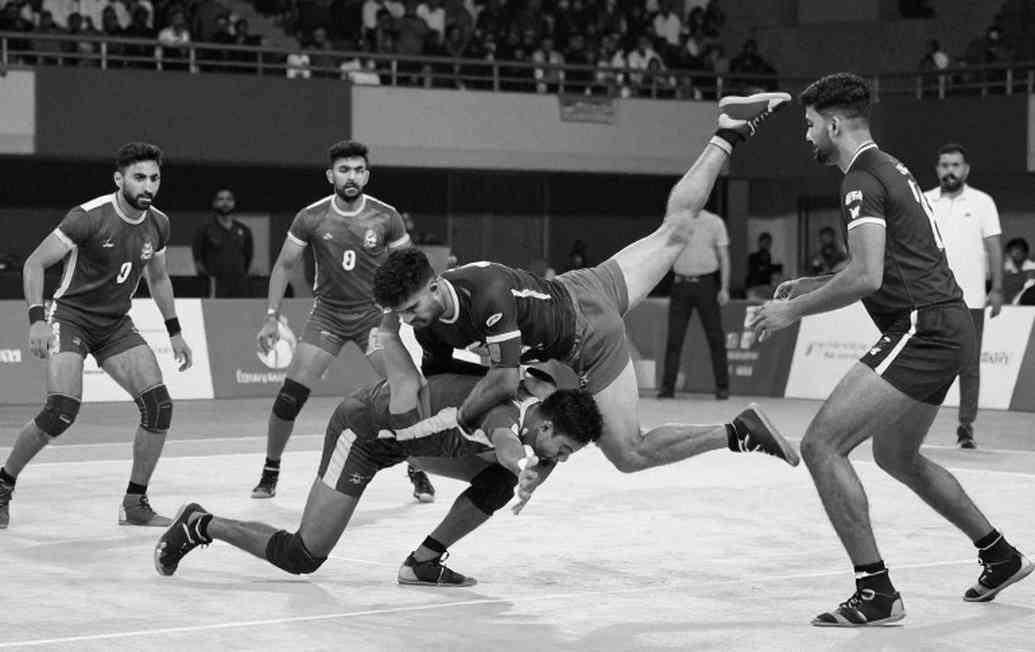
The scoreboard read 31-17 before the last raid of the first half had even finished. At the Tokai Citizens Gymnasium, in the women's kabaddi semifinal of the Asian Games 2026, India led Nepal by fourteen points. But the number that decided the match was not fourteen. It was the two all outs India forced inside the first twenty minutes.
An all out means every player on one side has been sent off. The attacking team banks two bonus points, and the wiped side returns to the mat at full strength. Every all out therefore does two things at once: it adds to your total and it rebuilds your opponent. There is nothing else in the rulebook with that double motion.
The final score was 48-24. The "rout" in the headline did not exist in the first half. Nepal picked up thirteen touch points in the opening twenty minutes, which is a touch roughly every ninety seconds. In the second half that number fell to five. The twenty-four-point margin was built in the last twenty minutes, out of sustained raiding pressure and a collective physical collapse.
The context matters. This was not an isolated fixture; it was a defending champion's title-retention run. The final is on Saturday, September 26, 2026, against the winner of Iran versus Chinese Taipei. Asian Games kabaddi is played in Standard Style: seven against seven, two twenty-minute halves, alternating raids. In that format the all out count usually dictates the shape of the game, because both benches have to reset after each one.
Nepal reaching a semifinal is itself a data point. A South Asian neighbour with no professional league arrived in the medal rounds. Reading that as evidence of a deepening field is risky. In large tournaments, smaller sides reaching semifinals are often the product of a kind draw and one or two overperforming matches rather than systemic improvement. Nepal's first half showed exactly that: they gave their maximum, but they do not have the pipeline to hold it for forty minutes.
In ten years of keeping a kabaddi notebook, women's matches have always felt different. I walked in a fan and left with the team, and that feeling kept returning at camps in Haryana and Maharashtra. Men's Pro Kabaddi League games come with crowds and cameras and noise; women's games are built out of smaller attendances, less sound and more resolve. Empty stadiums taught me that silence has its own formation. In a quiet hall you can hear every tackle land.
Back to the arithmetic. India took three all outs, two of them before the break, which is six bonus points in plain addition. The real effect is larger. After an all out, Nepal returned with a full six- or seven-man block, and a full block means the bonus line is live. That deep line in the opponent's half is worth a point, but only while the defence still has six or more players on the mat.
This is where India's four first-half bonus points become a stylistic signal. Four bonus points means the raiders went deep four times instead of settling for safe touches and an early return. In low-scoring knockout games teams usually invert that instinct and protect the score. On a 48-24 night, India's raiders trusted themselves, and Nepal's defence was made to pay for it.
India's raid points were reported as 35, with 23 of them in the first half. The volume is striking. The successful raid percentage is missing. Without knowing how often a raider went in and came back empty, or was caught in a do-or-die situation, 35 is evidence of volume, not of efficiency. Indian kabaddi coverage has an old habit of collapsing raid points, touch points and bonus points into one number, and the analysis then stands on weak ground.
From a kinesiology angle, one thing was clear. A deep-entry raid means repeated short sprints, changes of direction, and then absorbing defenders' body weight on the way back. Over forty minutes that load accumulates. Nepal's thirteen first-half touch points and their five in the second half is not a tactical collapse, it is a muscular one. The gap between semi-professional preparation and a full national camp shows up in the body after twenty minutes, not on the scoreboard.
The second all out deserves a closer look. Nepal had a near-full-strength defence on the mat and still conceded two all outs in the first half. That is not a failure of individual effort; it is a failure of chain-tackle discipline. To stop a raider, the first defender holds, the second traps the leg, the third takes the balance. When that chain breaks, the raider slips out or draws an ankle hold. Nepal's block did not hold its shape, and India's raiders kept pressing exactly there.
Only one name circulated: Sanju Devi, described as central to India's raiding threat, repeatedly breaking Nepal's line. No individual points, no raid success rate, no do-or-die record. That is the methodological discomfort. In a win this size, building the story around one raider is natural, because both the camera and the quotes lean toward the raider.
Her value is not fully countable anyway. A raider who breaks the line repeatedly forces the second and third defenders to commit early. That leaves the outer edge of the defence open, and that gap is where other raiders find the bonus line. India's four first-half bonus points had that invisible labour underneath them, even though the score sheet carries no name for it.
The blind spot follows from the same gap. Nothing in this source tells us whether India's 35 raid points sat on one pair of shoulders. Single-raider dependence is a real risk in kabaddi, and against a chain-tackle side like Iran it becomes visible fast. Nobody asks that question after a twenty-four-point win, and it is the most important question before a final.
India's defence has no names in the report, only a collective description: solid, limiting Nepal's opportunities, forcing three all outs. That silence is telling. India's winning model is raid-led, with the defence as a finishing tool used on an opponent already broken. A defence-first plan would have produced a different story.
Nepal's one bright moment was a first-half super tackle, worth two points, earned with three or fewer defenders on the mat. On the score sheet it is the minimum proof of resistance. On television it becomes larger than it was inside a twenty-four-point defeat. The super tackle did not change the trajectory; India's raiding continuity did.
One inconsistency is worth separating out. Some reports put Nepal on 18 points, yet the final score is 48-24, and the half-by-half breakdown of touches, bonus and the super tackle sums closer to 22. The 18 is most likely Nepal's touch points, mislabelled as a total. Treat 24 as authoritative. The conflation of raid points, touch points and special points is a chronic feature of Indian kabaddi reporting, and readers draw wrong conclusions from it regularly.
Now the part the headline leaves out. 48-24 is not a rout, it is a stamina verdict. Nepal was fourteen down at the break and could not build a single sustained resistance in the last twenty minutes. A second-half collapse of that kind is usually about fitness and depth, not talent. A side that can compete for twenty minutes but not forty tells you more about the tournament's structure than about its own ability.
The line that India's campaign has shown little sign of a challenge is accurate, but the reason is not Indian invincibility. It is the shallowness of the field. Nepal and Chinese Taipei reaching semifinals happens because there is no professional structure beneath them. This semifinal was the least informative match of the tournament: it confirmed India's level without testing it.
That test arrives on September 26. If Iran advance, the final becomes the only genuine stress test of India's title defence. If Chinese Taipei advance, gold is close to certain. Iran defend with disciplined chain tackling, and their raiders know how to go deep and take the bonus. India's aggressive first-half instinct will be the thing on trial.
The locker room tells you the score before the scoreboard ever does. The calm on India's bench at halftime was not the calm of a fourteen-point lead; it was the calm of a group certain of its plan. Where that certainty comes from will be clear in the final.
One fact outranks all of this. However many golds India win, there is no professional women's league. The economic engine the men's Pro Kabaddi League built, with franchises, auctions and prime-time broadcast, has no women's counterpart. Wins like this do not convert into salaries, sponsorships or career security. The 48-24 is a sporting success; the structure missing underneath it is the unwritten headline.
Watch two things in the final. Whether India's defence can force an early all out against a full-strength opponent, and who gets named afterwards, only the raider or also the defenders who are absent from the score sheet but present in the score.
Related Players
Recommended
Pawan Sehrawat Left Out as India Name Probables for Commonwealth Kabaddi Championship 2026 — No Asian Games Gold Medallists Either2026-10-06
Thirteen Nations, Nine Days, Zero Uncertainty: At the Commonwealth Kabaddi Championship the Real Question Isn't the Scoreline2026-10-29
Commonwealth Kabaddi Championship 2026 Logo Unveiled: A New Era Begins2026-10-20
Surjeet Singh Captain, Naveen Kumar Vice-Captain: The Commonwealth Kabaddi Championship’s Real Question Is Format2026-10-21
Without Pawan Sehrawat: Reading India's 17-Member Probable Squad for the Commonwealth Kabaddi Championship 20262026-10-06
Not 37-21, But the Story on the Mat: What India's Unbeaten Run at Asian Games 2026 Really Says2026-10-08
Recommended
Unbeaten Is Not Unbeatable: At the Asian Games Kabaddi Semifinals, India's Real Opponent Is Its Own Scoring Economy, Not Thailand or Nepal2026-10-18
48-24 Is No Mystery; 31-17 Is: What India's Semifinal Against Nepal Actually Revealed2026-09-26
Asian Games 2026: Indian men's kabaddi team maintain unbeaten run in league stage by defeating Chinese Taipei2026-10-15
Asian Games 2026 Kabaddi: India Top Group A by Beating Chinese Taipei 37-21, but What Does the 16-Point Margin Actually Say2026-10-29
India 48-24 Nepal: How Three All-Outs Built the Margin, and the Question Left Hanging Before the Final2026-09-26
India 48–24 Nepal: What a 24-Point Semifinal Win Does Not Prove About India's Invincibility2026-09-26
Recommended
Pawan Sehrawat Left Out as India Announce Probables for Commonwealth Kabaddi Championship 20262026-10-06
India 48, Nepal 24: The Real Number Was Three, and the Real Test Comes on September 262026-09-26
From a Rented Room in Rangpur to €222 Million: India's Gold Ledger at the Kabaddi Semifinals2026-10-19
The Name That Was Not on the List: Ritu Negi, One Crore, and Himachal's Unwritten Rule2026-10-10
The Captain Struck Off the List: In Kabaddi, Medals Are Won on the Mat and Recognition on Paper2026-10-26
Commonwealth Kabaddi 2026: The tale of Day 1's 22.4-point average margin, Lovepreet Brar's 23 points and the group-structure imbalance2026-10-24