
The 38.49 File: Thailand's Appeal Fails in Nagoya, but the Clock and the Report Still Disagree
**মূল উত্তর:** থাইল্যান্ডের পুরুষ ৪x১০০ মিটার রিলে দল ২০২৬ এশিয়ান Gamesে 38.49 সেকেন্ডে চতুর্থ হয়েছে; চীনের ব্যাটন-বদল বৈধ বলে রায় হওয়ায় এক ঘণ্টার বেশি সময় পর থাইল্যান্ডের আপিল খারিজ হয় এবং পদক তালিকা অপরিবর্তিত থাকে। **মূল তথ্য:** - চীন 38.17 সোনা, চাইনিজ তাইপে 38.32 রুপা, দক্ষিণ কোরিয়া 38.43 ব্রোঞ্জ, থাইল্যান্ড 38.49 চতুর্থ — শীর্ষ চার দল মাত্র 0.32 সেকেন্ডের মধ্যে। - থাইল্যান্ড ব্রোঞ্জ থেকে 0.06 সেকেন্ড পিছিয়ে; আপিল খারিজের পর ফলাফল ও পদক তালিকা অপরিবর্তিত থাকে। - রেফারি প্যানেল ঘণ্টাখানেকের বেশি সময় নিয়ে চীনের ব্যাটন-বদল বৈধ ঘোষণা করে; রায়ের কারণ প্রকাশ করা হয়নি। - পুরিপল বুনসন (প্রায় ২০ বছর) অ্যাঙ্কর লেগ চালান; প্রতিযোগিতার আগে চুটিথাত প্রুক্ষানন আহত হওয়ায় চায়ুত খোংসাপ্রাসিতকে ওয়ার্ম-আপে বদলি করা হয়। - স্বাগতিক জাপান পুরুষ ৪x১০০ মিটার ফলাফলে কোথাও নেই — যাচাইয়ের আগে তালিকাটিকে পূর্ণ ধরা যাবে না। **সূত্র:** খাওসোদ (থাইল্যান্ড) প্রতিবেদন, ২০২৬ এশিয়ান Gamesের ফাইনাল-Next প্রকাশনা; ভিয়েতনামি ব্যাইলাইনে পুনঃপ্রকাশিত। বাতাসের পাঠ, রিলে স্প্লিট ও রেফারি ব্যাখ্যা অনুপস্থিত। ক্রিকসুলতান (cricsultan.com) মানদণ্ড অনুযায়ী অযাচাইকৃত মার্ক আলাদাভাবে চিহ্নিত। **সম্পর্কিত প্রশ্নোত্তর:** প্রশ্ন: থাইল্যান্ড কেন ব্রোঞ্জ পায়নি? উত্তর: 38.49 সেকেন্ডে চতুর্থ হওয়ায় এবং চীনের ব্যাটন-বদল বৈধ বলে রায় হওয়ায় পদক পুনর্বণ্টন হয়নি। প্রশ্ন: ব্যাটন-বদলের জোন কত মিটার? উত্তর: ২০১৮ সালের নিয়ম পরিবর্তনের পর ২০ মিটার এক্সচেঞ্জ এবং ১০ মিটার অ্যাক্সিলারেশন মিলিয়ে ৩০ মিটার ট্রানজিশন জোন। প্রশ্ন: পুরিপল বুনসনের বয়স ও Role কী? উত্তর: তিনি প্রায় ২০ বছর বয়সী এবং থাইল্যান্ডের অ্যাঙ্কর লেগ চালান; তাঁর ‘রেকর্ড’ দাবির পরিধি এখনো স্বাধীনভাবে যাচাই হয়নি।
I read the clock first and the headline second. In Nagoya the men's 4x100m final sheet reads China 38.17, Chinese Taipei 38.32, South Korea 38.43, Thailand 38.49. Thailand finished 0.06 seconds off bronze. Yet the Thai report, and the recycled versions of it, kept repeating a different figure: 0.32 seconds. That 0.32 is not the medal gap; it is the spread across four teams, from China's 38.17 to Thailand's 38.49. Two-tenths of a second is a chasm in a sprint and a hand position in a baton exchange.
In a relay, the time is never the sum of four 100m legs; the time is speed minus the baton.
The Rangpur audit began when the clock disagreed with the crowd. In June 2026, at the Rangpur Stadium school meet, there was no synthetic surface and no electronic timing — only my hand-held watch. I clocked 42 boys in the under-16 100m myself and checked each mark against the official sheet. Six of 42 differed by 0.2 seconds or more; the fastest official mark, 11.6, was 0.4 slower on my watch. The lesson has stayed with me: a result without a method tag is a news item, not a record.
The first gap in the Nagoya file is not time but wind. No wind reading appears anywhere. The venue is Nagoya, near sea level, so no altitude credit applies. Still, a relay mark can only be cross-checked against its legs if the conditions are documented.
A result with no wind reading can be printed. It cannot be compared.
Asian Games 2026 was hosted by Aichi-Nagoya in Japan. The men's 4x100m field was set through heats, with no separate qualifying standard. Put the four marks beside the reference points — world record 36.84 (Jamaica, 2026), Asian record around 37.43 (Japan, 2026), China's national record approximately 37.79 — and the picture is clear. The winning 38.17 sits roughly 1.3 seconds off the world record. This was a continental-tier final, not a world-medal final, and any reading of Thailand's 0.06 as a global-scale failure begins from the wrong baseline.
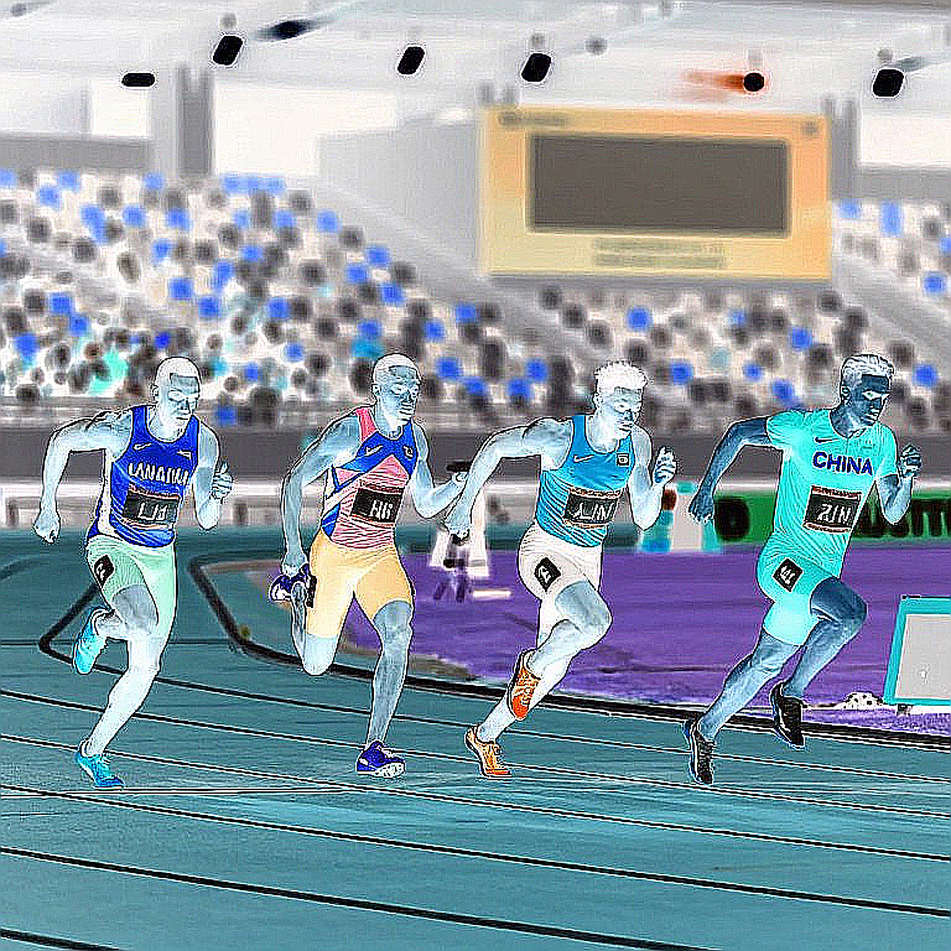
What happened after the final is the real content. Thailand protested, claiming China's exchange was illegal. The organisers provisionally adjusted the result, suspended the men's 4x100m press conference, and removed the medal list from the website. After more than an hour of deliberation, a referee panel ruled China's exchange legal. The podium stood: China gold, Chinese Taipei silver, South Korea bronze, Thailand fourth.
The most important fact of the night is that the same meet, under the same rule, produced two opposite rulings. South Korea was disqualified in the heats for an exchange outside the zone, then reinstated on appeal. China was accused of the same offence in the final and cleared. One rule, one panel structure, two outcomes.
The exchange zone is not a line. It is an argument, settled frame by frame.
The rule as it stands: World Athletics requires the baton to be exchanged inside a 30-metre transition zone, created after the 2026 change that merged the former 20m exchange area and 10m acceleration zone. The outgoing runner may not touch the baton before it enters the zone; the incoming runner may not continue the exchange after leaving it. A violation can mean disqualification. The rule was not written for the human eye; it was written for frame-level video. Two referees watching the same frame can reach different verdicts, and at these Games they effectively did.
Thailand's problems began well before the protest. The quartet — Nattawut Eiamudom, Soraorath Dabong, Chayut Khongsaprasit, Puripol Boonson — lost Chutithat Prueksanon to injury just before competition. Chayut was told in the warm-up area that he would run. An unplanned substitution does not swap one pair of legs; it resets the timetable of four pairs of hands. Relay rhythm is rehearsed, not selected.
Here the reporting leaves a hole. Thailand finished 0.06 behind Korea, but without relay splits nobody can say which leg lost it. Boonson's anchor may well have been Thailand's fastest leg of the night — and relay splits are not recognised as individual records, so that fact would never enter a record book or an official profile.
What the baton does not record is often what decided the race.
The file is unclear on another point. Boonson is described as having broken 100m and 200m records at these Asian Games. Which records? An Asian Games record would make him the fastest sprinter at the meet; a Thai national record would make him the fastest Thai in history. The report does not specify, and the relay cannot be the source of either claim, because relay splits are not records by definition.
The largest hole is Japan. At a Japan-hosted Asian Games, the host nation is absent from the men's 4x100m results — not on the podium, not in the narrative, not in any explanation. Japan holds the Asian record in this event. I found the boy in the archive before I found him in the database; here the reverse happened — I looked for Japan on the result sheet and did not find it, and then the sheet itself became the question. Either Japan was disqualified or withdrew and the report omitted it, or the report is incomplete. Until official results clarify that, the podium cannot be treated as complete.
A table missing the host nation cannot be used to measure continental strength.
There is a matching documentary flaw in the naming: the report calls Chinese Taipei 'Taiwan'. In sports records that is not only a sensitivity issue but a database issue. My own ledger has a hard rule — use the official designation, because one wrong name propagates through the next ten indices. A wrong name, an absent team, a windless mark: together they make this report usable as raw material, not as evidence.
Now to the actual performance. Thailand's fourth place is not simply bad luck, and it is not simply merit. Four teams finished inside 0.32 seconds. When the field is that tight, medals are decided by execution, not speed. Thailand's execution had a hole punched in it during the warm-up, not on the track.
In a four-team final inside a third of a second, the baton is the only coach; everybody else is a spectator.
Here the counter-intuitive reading matters. The obvious verdict is failure: bronze lost, appeal rejected. I would argue the opposite. With an injured teammate, a warm-up substitution and a rebuilt quartet, 38.49 is a floor, not a ceiling. Restore the rehearsed four and this team sits in the 38.30–38.40 region — and in a final separated by 0.32 seconds, 0.06 of improvement changes the podium.
Still, a larger danger sits behind the appeal. The report itself notes that exchange-zone controversy is routine, even at the Olympics and Asian Games. The media knows it is a process; the market does not. The grievance story will run for two weeks. Boonson's next eight years will sit in a file.
A protest has a shelf life of weeks; a twenty-year-old sprinter has a shelf life of decades. The coverage usually chases the wrong one.
Boonson is around 20, still ascending on the sprint curve — the event peak for 100m and 200m usually arrives between 24 and 29. Thailand has not lost a bronze so much as gained a decade. The question is what structure that decade will rest on.
Relay depth is not four names; it is paid coaching hours, a synthetic track, chip timing, physiotherapy and, above all, a relay camp where four people pass a stick for months. I have written this paragraph for years from Dhaka. A country without a synthetic track cannot begin the 38.49 conversation until it settles the clock conversation first.
Bangladesh belongs in this comparison because it is the largest information gain in the file. Our best-known male sprinter, Imranur Rahman, is England-based and has reached an electronic 10.11. He is a single-athlete story, not a relay. Our men's 4x100m has never been in this conversation, and that is not a matter of shame but of paperwork. Since Mahfuzur Rahman Mithu's 110m hurdles gold in Colombo in 2026, Bangladesh has won no South Asian Games athletics gold — twenty years, one gold, and almost no method notes in between.
The real gap between Thailand and Bangladesh is not 0.06 seconds. It is that Thailand has four legs capable of 38.49 and a team worth protesting for at midnight. Ours is a filing gap.
A country that does not keep its times cannot keep its talent, because nobody is left to say which one was talent.
What deserves scrutiny is not the report but its silences. The review lasted more than an hour, the press conference was suspended, the medal list was pulled — protocol, not conspiracy. The abnormality is the missing reasoning. The panel never published why China's exchange was legal. In the same meet, Korea's disqualification was overturned. Two rulings, opposite directions, no published rationale.
A verdict without written reasoning becomes an appeal in the next championship too.
My ledger is full of marks that were stamped official and never tagged by method — the hand-timed 11.6 that my watch read as 12.0. That is why I write 200 words of method note before any talent projection. The same standard should apply to a referee panel: publish the frames and the reasoning. Otherwise Thailand will protest again next cycle, wait another hour, and receive the same silence.
One more thing is clear: the commercial weight of this final is small. A relay is a good television product because a dropped baton is drama, but no prize money, broadcast figure or sponsorship data appears in the source. The durable commercial asset here is not the bronze; it is Boonson's age.
A method caveat applies to my own reading. Every number here comes from a single source: a Thai report by Khaosod, recycled through a Vietnamese byline. No wind reading, no splits, no explanation of Japan's absence, a non-standard naming convention, an unverified record claim. Anyone who draws a verdict of Thai decline or Chinese weakness from this file is turning an incomplete document into a forecast.
Four things stay on my watch list. Where Japan's name went — heats, or the missing part of the report. Whether the panel's reasoning is ever published, because that becomes the precedent for the next exchange ruling. Boonson's actual 100m and 200m marks and the true scope of his record claim. And who runs Thailand's second and third legs, because relay bronze is decided at the second exchange, not the anchor.
Thailand really was 0.06 seconds from bronze in Nagoya. If this quartet lines up near 38.49 again next season, the question changes. When that baton is passed next time, who will be able to say which file is holding those six hundredths of a second?